







For nearly a century, mathematicians have struggled with one of the most famous questions in modern mathematics: whether the equations describing fluid motion can develop a mathematical breakdown.
Now, artificial intelligence has entered the picture.
OpenAI says its AI system has produced a solution to the long-standing Navier–Stokes existence and smoothness problem, one of the seven Millennium Prize Problems. The challenge carries a $1 million prize from the Clay Mathematics Institute, although OpenAI has said it will not claim the award if its work is eventually accepted.
What Is the Navier–Stokes Problem?
The Navier–Stokes equations are used to describe how fluids move. They are fundamental to areas ranging from weather and ocean modelling to aircraft design, pumps and turbines.
The equations themselves have been known since the 19th century. The difficult question is whether their solutions always remain mathematically well behaved or whether certain conditions can cause them to break down.
One possibility is a phenomenon known as a “blowup”, in which the equations predict quantities such as fluid velocity becoming infinitely large in a finite amount of time. Proving whether such a breakdown can occur is at the heart of the Millennium Prize challenge.
How AI Approached the Problem
OpenAI reportedly used thousands of AI agents working simultaneously on the mathematical challenge.
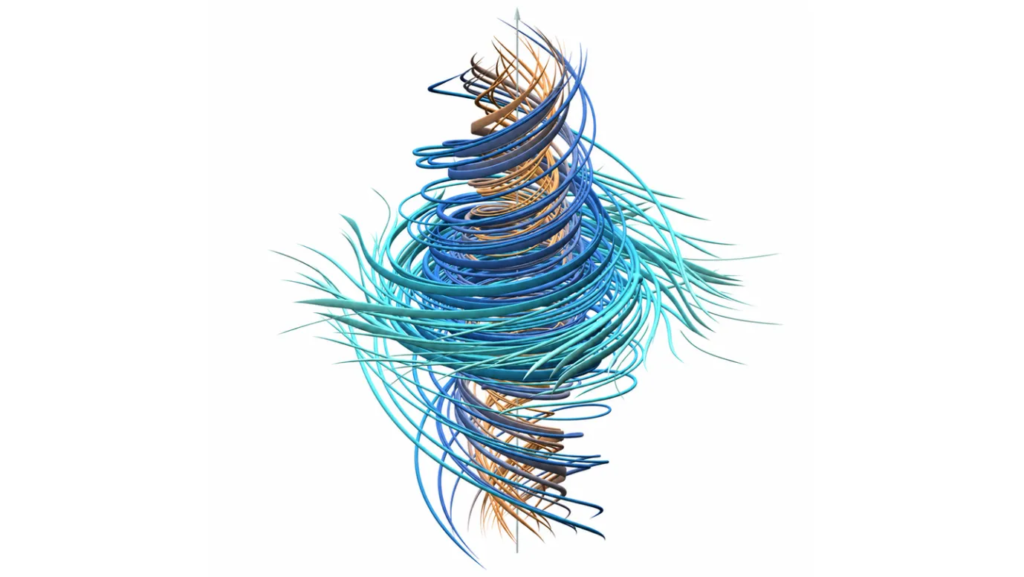
The system eventually identified a scenario involving a vortex that becomes increasingly narrow and faster, potentially reaching an infinite velocity in finite time. According to OpenAI, this provides a route toward demonstrating that the Navier–Stokes equations can indeed develop a singularity.
The proposed proof is extensive, running to more than 160 pages. It has also been checked using Lean, a computer system designed to formally verify mathematical proofs.
However, formal verification does not mean the wider mathematical community has finished examining the work. Researchers are still studying the proof and its underlying ideas.
Why the Discovery Is Controversial
The mathematical result has arrived alongside a debate about scientific credit and the role of AI in research.
Mathematicians Tristan Buckmaster and Levent Alpöge had been working on a closely related fluid-dynamics problem using AI assistance. Their research involved the forced Euler equations, which do not include the viscosity term present in the Navier–Stokes equations.
Questions have since emerged over how the different pieces of research are connected and whether earlier work influenced OpenAI’s development. OpenAI has denied that its AI systems directly accessed the researchers’ private work, while acknowledging that it cannot completely rule out indirect influence from de-identified product data.
What It Could Mean for Science
The significance of the development goes beyond one mathematical problem.
AI systems are increasingly being used to explore difficult mathematical questions, test possible approaches and verify complex reasoning. The Navier–Stokes case could become an important example of how humans and AI systems might work together on problems that have resisted traditional methods.
At the same time, it raises a fundamental question: Who deserves credit when an AI system discovers a mathematical result by building on decades of human knowledge?
That question may become increasingly important as AI takes on more advanced scientific research.
A Breakthrough Still Being Examined
For now, the safest description is that AI has produced a potentially groundbreaking solution rather than declaring the century-old problem permanently settled.
Mathematicians still need to examine the complete argument carefully and determine whether every step meets the standards required for a definitive solution.
If the proof survives that scrutiny, the achievement could mark a major moment in mathematics — and a striking demonstration of how artificial intelligence is beginning to change the way difficult scientific problems are approached.