





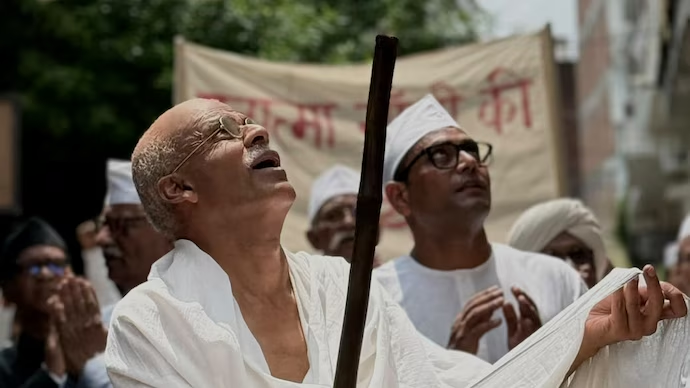
Manoj Bajpayee has taken on one of the most recognisable faces in Indian history, but his first look as Mahatma Gandhi suggests that the upcoming film is aiming for something more than a conventional historical portrayal.
The actor appears almost unrecognisable in the newly released images, complete with Gandhi’s familiar round glasses, white clothing, bald appearance and walking stick. The transformation has immediately drawn attention, but the bigger curiosity lies in the story behind the look.
Directed by Sudhir Mishra and produced by Anubhav Sinha, the yet-untitled historical drama focuses on a relatively lesser-known 21 day chapter in Gandhi’s life during India’s transition to independence.
A Gandhi story that isn’t about his entire life
Films about Gandhi have often concentrated on the major milestones of his public life the freedom movement, his philosophy of non-violence and his relationship with India’s political leadership.
Sudhir Mishra’s project appears to be taking a narrower route.
Instead of attempting to tell Gandhi’s entire life in a few hours, the film concentrates on a short but significant period when India was moving towards independence and the political centre of the country was changing rapidly.
According to Mishra, the story examines Gandhi’s decision to step away at a crucial moment and asks what was happening beneath the historical events that are already familiar to audiences.
That smaller time frame could allow the filmmakers to explore the person behind the historical symbol.
Why Manoj Bajpayee makes the casting intriguing
Playing Gandhi requires more than physical resemblance.
For Bajpayee, the challenge is particularly interesting because his screen identity has largely been built around characters with strong psychological intensity. Whether playing flawed individuals, morally complicated figures or deeply emotional characters, the actor is known for performances that focus heavily on internal conflict.
Gandhi, meanwhile, is one of the most familiar figures in Indian history.
That creates an unusual acting challenge: how do you make an audience look at a person they already think they know?
The first look suggests that Bajpayee and the filmmakers have paid considerable attention to Gandhi’s physical appearance. Reports also say Bajpayee underwent significant weight loss and adopted a restricted diet and lifestyle for the role.
But the real test will come when the character begins speaking and interacting with the people around him.
Sudhir Mishra brings a different filmmaking sensibility
The director’s involvement is another reason the project has attracted attention.
Sudhir Mishra has spent decades making films centred on politics, society, ambition and complicated human relationships. His filmography includes Dharavi, Hazaaron Khwaishein Aisi and Is Raat Ki Subah Nahin, among other socially and politically driven projects.
That background could make this less of a conventional historical spectacle and more of a character-driven examination of Gandhi during a moment of uncertainty.
The filmmaker has also revealed that the project has a personal connection for him. He has spoken about stories of Gandhi he heard from his mother, who had her own complicated feelings about the leader and a family connection to the freedom struggle.
A film about history and how history is remembered
One of the more intriguing elements of the project is its reported interest in the difference between historical events and the way later generations interpret them.
Mishra has described the film as involving an actor’s dilemma alongside Gandhi’s story and contemporary perceptions of him.
That approach could give the film two layers.
On one level, audiences will see Gandhi during a pivotal period of India’s independence.
On another, they may be encouraged to consider how a historical personality becomes an image, a symbol and eventually a subject of competing interpretations.
Saurabh Shukla reunites with Bajpayee
The film also brings Saurabh Shukla back together with Bajpayee.
The two actors previously shared the screen in Satya and Aarakshan, making their reunion another interesting part of the project. Shukla is part of the ensemble in this new historical drama.
Their earlier collaborations are remembered for performances grounded in character rather than conventional star presentation, making the reunion particularly appealing to followers of Hindi cinema.
Anubhav Sinha adds another layer
The film is being produced by Anubhav Sinha, whose own filmmaking career has frequently dealt with political and social subjects.
His work as a director includes films such as Mulk, Article 15 and Thappad. His involvement as producer places the Gandhi project within a broader tradition of Hindi cinema that attempts to use popular filmmaking to examine difficult social questions.
Sinha and Mishra have therefore brought together two filmmakers with established interests in stories that extend beyond straightforward entertainment.
The first look is only the beginning
The newly released images have answered one question: what will Manoj Bajpayee look like as Gandhi?
They have also created several more.
How will Bajpayee approach Gandhi’s voice, mannerisms and temperament? How much of the film will focus on the historical figure and how much on the individual behind the public image? And how will Mishra turn a 21-day period into a compelling cinematic narrative?
Those answers will have to wait.
Filming is currently underway in Lucknow, with the production expected to continue there through October. The filmmakers have yet to announce the final title and release date.
Why this Gandhi film could be different
The most interesting thing about the project may ultimately be what it chooses not to do.
It is not attempting to compress Gandhi’s entire life into one familiar biographical timeline. Instead, it is focusing on a short period and using that window to examine a leader at a moment of major historical change.
For an actor as intensely character-driven as Manoj Bajpayee, that creates an opportunity to move beyond simply resembling Gandhi.
The real challenge will be to make audiences see the human being behind the iconic image.
And that is perhaps what makes the first look so intriguing: the transformation may have begun with the appearance, but the performance will determine whether this Gandhi feels like a portrait of history or a living character.