








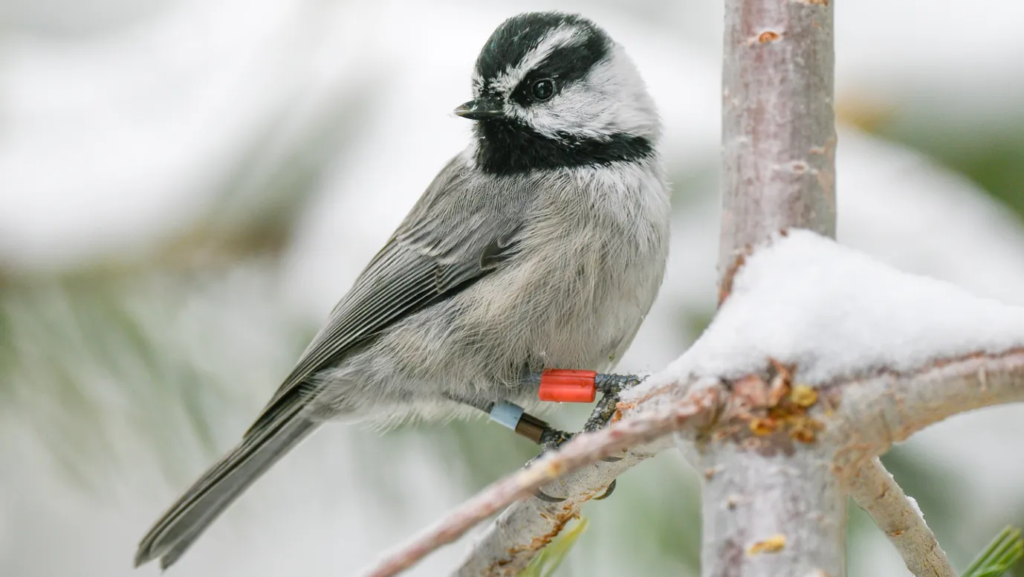
For a tiny mountain chickadee, remembering where food is hidden can mean the difference between surviving winter and freezing in the cold.
Scientists studying wild mountain chickadees in California’s Sierra Nevada have found that these small birds possess remarkable spatial memory. Some can keep track of as many as 100,000 individual seed caches, helping them locate food even when deep snow covers the forest floor.
Memory Becomes a Survival Tool
Mountain chickadees live through extremely harsh winters, with snow sometimes reaching several metres deep. The birds hide seeds in tree crevices and other locations during better weather, then rely on their memory to recover them later.
Researchers at the University of Nevada, Reno have been studying these birds in the wild since 1999. Their work has become one of the longest-running field studies of animal cognition.
The researchers use specially designed feeders fitted with microchips to test how quickly individual birds learn locations and adapt when those locations change.
Smarter Birds May Live Longer
The long-term research has revealed a striking connection between intelligence and survival.
Earlier findings showed that birds with stronger spatial cognitive abilities were more likely to live longer. Around two-thirds of the birds do not survive their first winter, while those that make it can sometimes live for more than a decade.
What About Ageing?
Scientists also expected older birds to experience some decline in memory. Instead, tests involving 804 chickadees found no clear age-related decline in their cognitive abilities.
Researchers described the older birds as remaining remarkably sharp, raising new questions about how some animals maintain cognitive performance as they age.
Gut Bacteria Could Also Play a Role
Genetics explains a large share of the differences in cognitive ability among these birds. But researchers are investigating another possible factor: the gut microbiome.
In a study of 41 birds, those with better spatial memory had more bacteria associated with producing short chain fatty acids, compounds that have been linked to brain health in other research. Scientists stress that this connection is still being investigated and does not yet prove that gut bacteria directly improve memory.
Why These Birds Matter
The chickadee research shows how intelligence can evolve as a practical survival advantage. Memory is not simply a measure of how clever an animal is for these birds, it can determine whether they successfully find food, survive winter and reproduce.
By studying cognition in animals in their natural environment, scientists hope to better understand how memory, ageing, genetics and behaviour interact in the real world.