







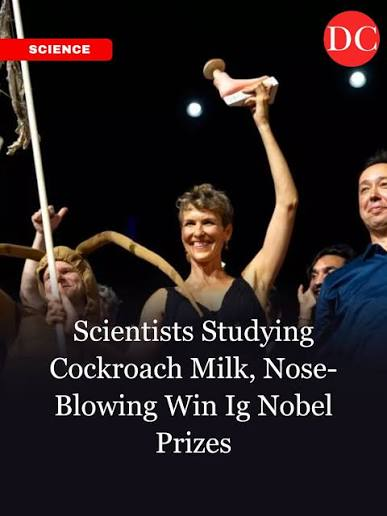
What happens when scientists investigate questions that sound completely bizarre but actually have serious scientific value? The answer is the Ig Nobel Prizes, an annual celebration of research that aims to make people laugh first and think afterwards.
The 2026 awards, held in Zurich, Switzerland, recognised some wonderfully unusual studies, including research involving old underwear, venomous snakes, cockroach milk and even toilet splashes.
Scientists Buried Underwear to Study Soil
One of the strangest experiments involved nearly 1,000 pairs of cotton underwear.
Researchers and citizen scientists buried the garments in soil and later dug them up to see how much they had decomposed. The idea was surprisingly practical: the amount of decomposition could reveal the biological activity of the soil.
More active soil contains microorganisms capable of breaking down cellulose, so the condition of the underwear became a simple indicator of soil health.
What Makes a Kiss a Kiss?
Another winning study attempted to give something as familiar as a kiss a scientific definition.
Researchers compared kissing-like behaviour across different animal species and developed a definition based on oral contact, movement of the mouth and the absence of food transfer.
It may sound humorous, but the researchers were exploring how behaviours evolve across species.
Scientists Investigated Why Snakes Bite
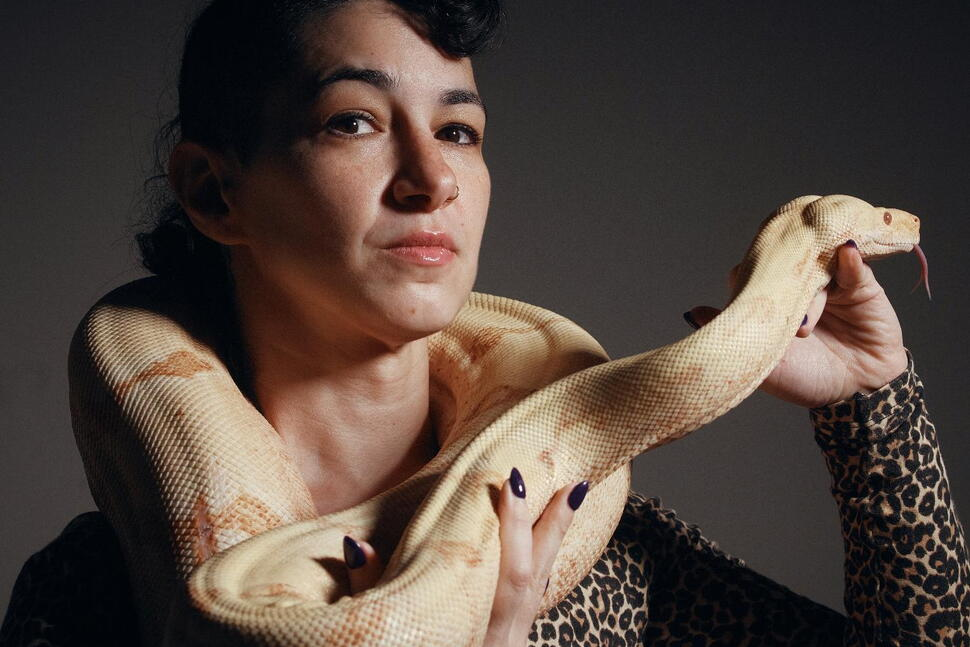
The biology award went to research investigating when venomous snakes are more likely to deliver a defensive bite.
Researchers studied how snakes responded when pressure was applied to different parts of their bodies. The experiment was designed to understand how defensive behaviour varies depending on where a snake is touched or stepped on.
The unusual experiment also highlights why understanding animal behaviour can matter when reducing dangerous encounters.
Even Toilet Splashing Got Scientific Attention
Another study tackled a problem familiar to public restroom users: splashback.
Using mathematical models and experiments, researchers investigated how the angle at which liquid hits a urinal affects splashing. Their findings were used to develop designs intended to significantly reduce the problem.
Why These Strange Studies Matter
The Ig Nobels may look like a celebration of strange science, but many of the winning projects answer practical or genuinely interesting questions.
From understanding soil ecosystems to studying animal behaviour and fluid dynamics, the research shows that scientific curiosity can begin with almost anything.
That is precisely what makes the Ig Nobel Prizes different: even the strangest question can sometimes lead to a useful discovery.