







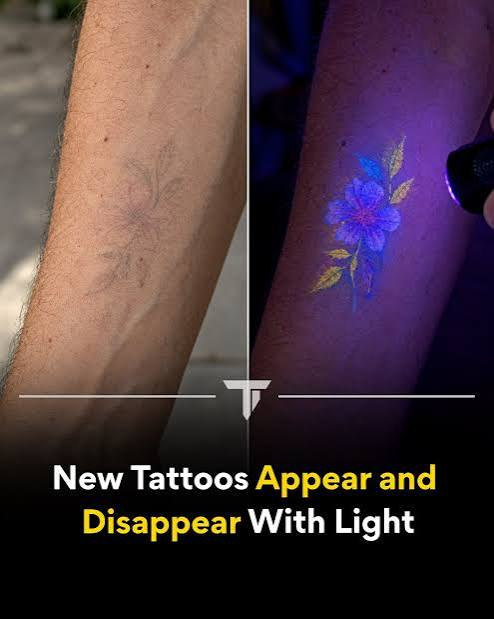
Scientists are developing a new type of tattoo ink that remains invisible under normal lighting but becomes visible when exposed to ultraviolet (UV) light. The technology could eventually offer new options for medical tattooing, including marking specific areas of the skin for procedures such as radiotherapy.
The research, reported by Nature on October 9, 2026, explores how light-responsive dyes can be adapted for use beneath the skin. However, more testing is needed before the technology can be widely used.
How Do Invisible Tattoos Work?
The inks use photochromic dyes, which change colour when exposed to particular wavelengths of light. These materials are already used in products such as transition lenses and some textiles.
For the new tattoo inks, tiny transparent acrylic spheres contain the light-sensitive compounds. When the compounds absorb UV light, their chemical structure changes, making the colour visible. Exposure to bright visible light can reverse the process and make the ink appear invisible again.
Scientists Test Three Coloured Inks
Nanoscientist Carson Bruns at the University of Colorado Boulder and his team developed three coloured dyes in magenta, yellow and blue.
The researchers tested the inks on pig skin and silicone skin models. These experiments helped them explore how the materials behave and whether their visibility can be controlled using different types of light.
The findings were reported in the journal Matter Light.
Could Invisible Tattoos Help With Radiotherapy?
One potential application is medical tattooing. Patients receiving radiotherapy sometimes have small skin marks that help clinicians align treatment accurately.
An ink that remains hidden during everyday life but becomes visible under a specific light source could offer an alternative to permanently visible markings. However, researchers would need to establish that the material is safe, stable and reliable before it could be used for this purpose.
From Experimental Ink to a Potential Technology
Bruns previously developed a photochromic tattoo ink known as Magic Ink, which turns magenta under UV light. That technology was commercialised in 2024 through his start-up, HYPRSKN.
The newer research expands the approach by exploring multiple colours and the possibility of making tattoos visible and invisible under controlled lighting conditions.
Safety Questions Remain
A material designed for use inside the skin must meet demanding safety standards. Researchers still need to investigate its long-term stability, potential skin reactions and behaviour after implantation.
Testing on pig and silicone skin does not establish that the inks are safe for widespread human use. Further research and regulatory evaluation will be necessary before any medical application becomes routine.
What This Innovation Could Mean
Light-responsive tattoo inks could eventually bridge cosmetic tattooing and medical technology. Their ability to appear or disappear under different lighting conditions may provide new ways to create discreet markings.
For now, the technology remains an emerging area of research, with its future applications depending on further evidence of safety and performance.
