








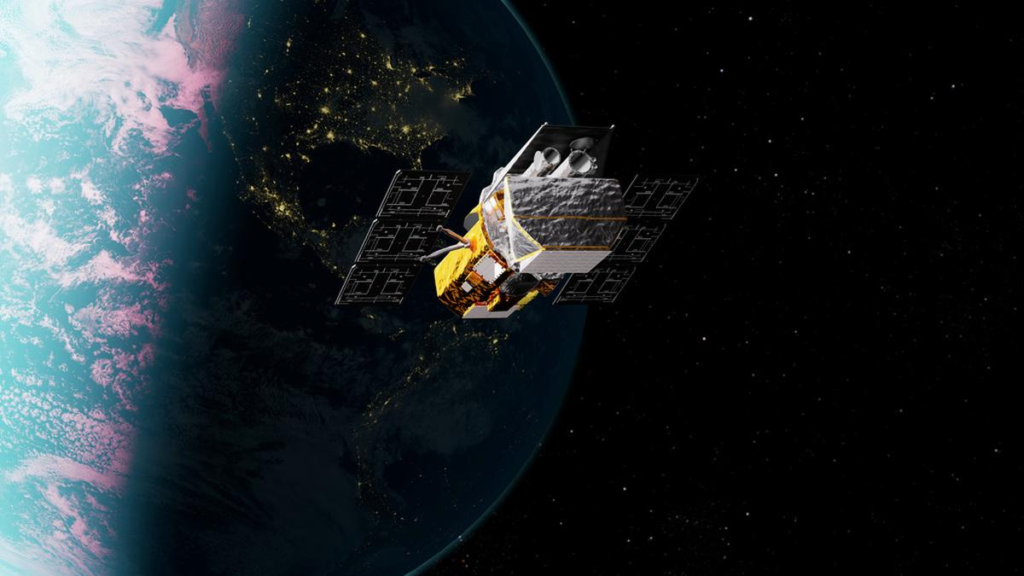
A private robotic spacecraft sent on an ambitious mission to extend the life of NASA’s aging Swift Observatory has returned to Earth after the rescue effort was abandoned.
The spacecraft, named Link, re-entered the atmosphere on September 25, ending a mission designed to demonstrate how satellites could be serviced and moved to safer orbits.
A Mission to Save Swift
NASA’s Neil Gehrels Swift Observatory has been studying some of the universe’s most powerful and rapidly changing events since its launch in 2004. The telescope is particularly known for observing gamma-ray bursts and other cosmic explosions.
However, increasing atmospheric drag caused Swift’s orbit to fall faster than expected. The planned solution was to use Link to capture the telescope and raise it into a higher orbit.
Technical Problems Hit Link
Link launched on July 3 but soon experienced problems with its orientation-control systems. Two of its three reaction wheels stopped functioning, while a faulty valve later caused the spacecraft to spin rapidly.
Although engineers eventually regained control, the problems consumed valuable fuel. By August, there was not enough fuel remaining to safely perform the planned rescue operation.
Link Still Reached Swift
Even after the rescue was cancelled, the spacecraft continued to demonstrate its capabilities. Flight controllers managed to bring Link within roughly 12–15 kilometres of Swift and capture images of the aging telescope.
The close approach provided useful experience for future missions involving satellite inspection and servicing.
Swift Continues Its Final Observations
Swift itself remains in orbit for now. NASA restarted some of its scientific instruments in August after temporarily reducing observations to slow the spacecraft’s descent and support the rescue effort.
With no orbital boost, however, Swift’s altitude will continue to decline. Current expectations point to atmospheric re-entry in the coming weeks.
Lessons for Future Space Missions
Although Link did not complete its primary objective, NASA and Katalyst Space Technologies described the mission as an opportunity to develop experience in commercial satellite servicing.
The ability to repair, refuel, inspect or reposition satellites could become increasingly important as more spacecraft operate in Earth orbit. The Swift mission has provided engineers with practical experience in rendezvous operations and robotic servicing under challenging conditions.
The Future of Satellite Rescue
The mission highlights both the potential and difficulty of extending the lives of spacecraft already in orbit. As valuable satellites age, robotic servicing could offer an alternative to replacing them entirely.
Link’s mission may therefore serve as an important test case for future efforts to keep scientific observatories and other spacecraft working for longer.