







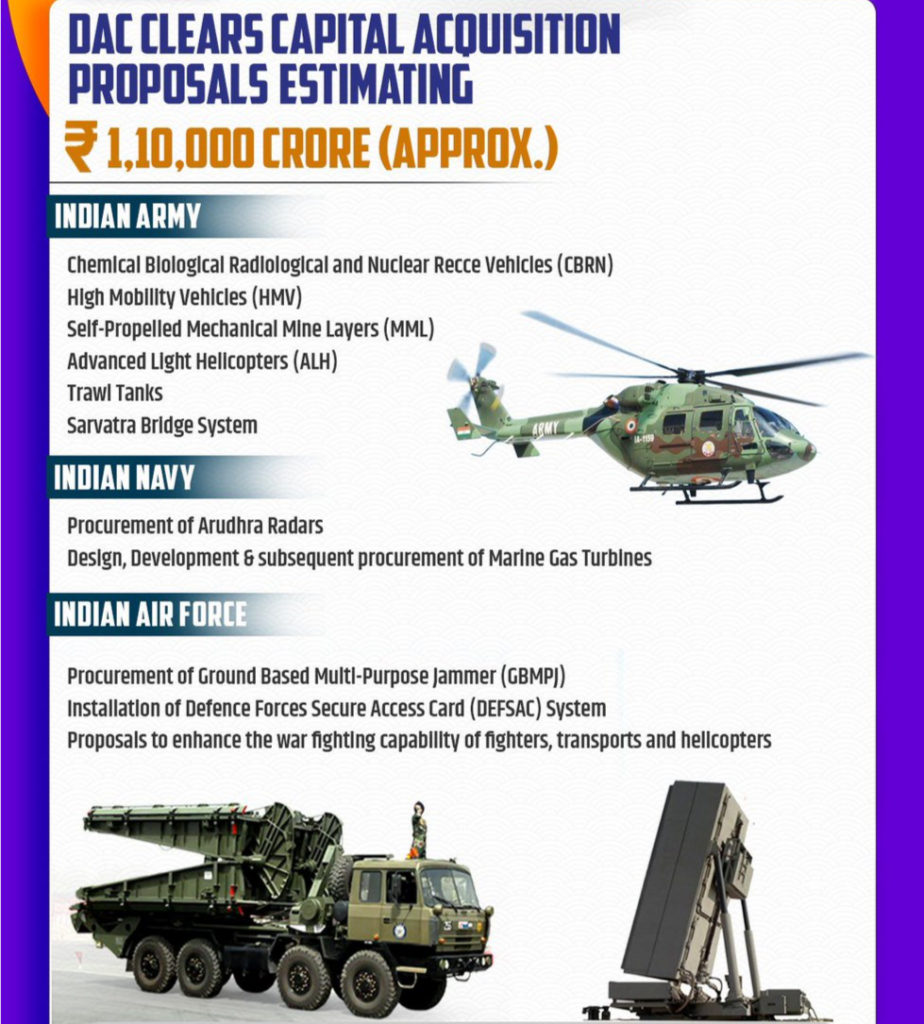
In a major push for military modernisation and self-reliance, the Defence Acquisition Council (DAC), chaired by Defence Minister Rajnath Singh, on Monday accorded Acceptance of Necessity (AoN) to capital acquisition proposals worth approximately ₹1.10 lakh crore for the Indian Army, Navy and Air Force.A standout feature of the approvals is that around 98% of the procurements will be sourced from the Indian industry, reinforcing the government’s Atmanirbhar Bharat and Make in India vision in the defence sector.
INDIA the Army will receive a range of systems to enhance mobility, reconnaissance and combat support:Chemical, Biological, Radiological and Nuclear (CBRN) Recce Vehicles capable of detecting, identifying, monitoring and marking contaminated areas High Mobility Vehicles (HMVs) for better logistics and operations in challenging terrains Self-Propelled Mechanical Mine Layers (MML) for rapid and responsive mine-laying Advanced Light Helicopters (ALHs / Dhruv) multi-role helicopters for complex missions across terrains Trawl Tanks — specialised vehicles to clear minefields Sarvatra Bridge System — for composite crossings over varied obstacles
Indian Navy Arudhra Radars — to replace existing Air Route Surveillance Radars at naval air stations, improving air traffic and surveillance capabilities Design, development and subsequent procurement of Marine Gas Turbines (MGTs) — indigenous warship propulsion systems aimed at reducing dependence on foreign vendors
Indian Air ForceProposals to enhance the war-fighting capability of fighters, transport aircraft and helicoptersGround-Based Multi-Purpose Jammers (GBMPJ) — for effective electronic warfare against adversary radarsDefence Forces Secure Access Card (DEFSAC) system — an interoperable RFID-based smart card system that will replace traditional paper-based identity cards, passes and permits across the services
The scale of the approvals underscores India’s accelerated focus on modernising its armed forces while building a robust domestic defence industrial base. By prioritising indigenous sourcing, the government aims to create jobs, boost technology development, and reduce strategic vulnerabilities linked to foreign supply chains.Defence Minister Rajnath Singh highlighted the commitment, stating that the high share of Indian industry procurement “shows our commitment towards developing a strong defence industrial base in India.”The AoN is the first formal step in the procurement process. Contracts will follow after detailed trials, negotiations and further clearances. These systems are expected to significantly improve operational readiness, mobility, surveillance, electronic warfare and force protection across all three services.This latest decision continues the series of large indigenous-focused acquisition packages cleared in recent years, signalling a clear shift towards self-reliance in critical defence technologies.