








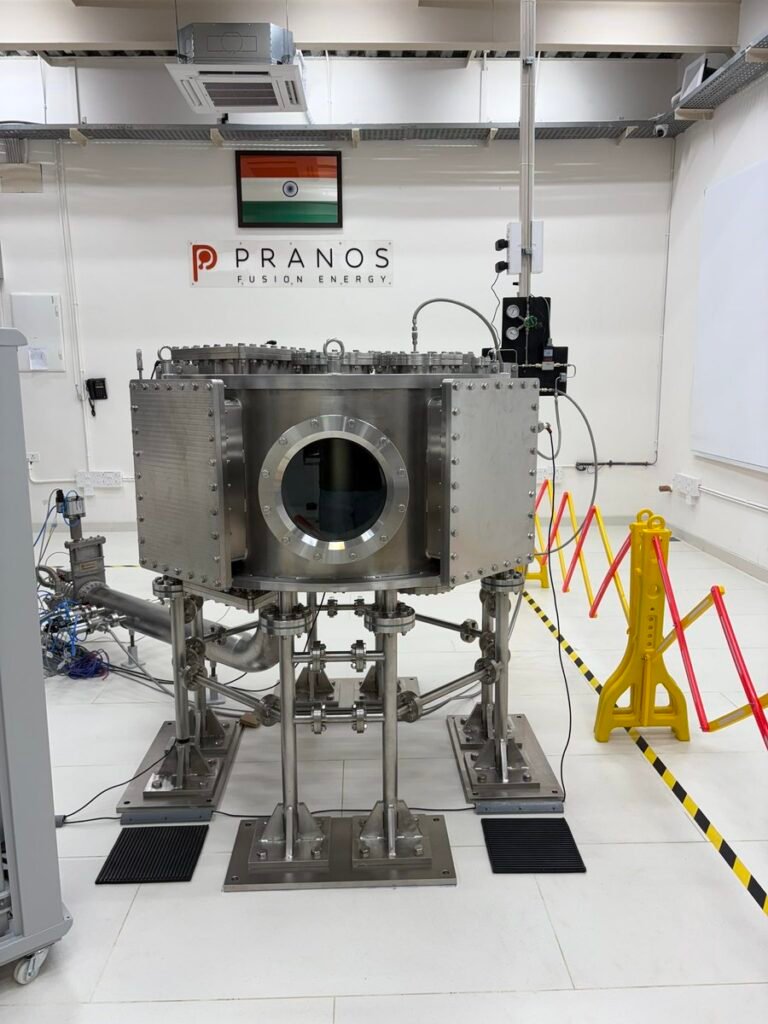
India is making a significant move in the global race for nuclear fusion technology with PRAGYA, a compact tokamak developed by Bengaluru-based deep-tech startup Pranos Fusion. The development highlights the growing role of India’s private sector in one of the world’s most ambitious energy research fields.Tokamaks are experimental machines designed to create and control extremely hot plasma using powerful magnetic fields. The ultimate goal of fusion research is to reproduce the energy-producing process that powers the Sun and stars, potentially creating a future source of energy with very low carbon emissions.
PRAGYA is being developed as a compact, low-aspect-ratio tokamak and experimental platform for studying hot plasma and advancing fusion-related technologies. Rather than being a commercial power plant, the machine is intended to provide researchers and engineers with a platform to study plasma behaviour, magnetic confinement and advanced control techniques.Pranos Fusion has positioned PRAGYA as part of a broader technology-development programme involving plasma control, tokamak engineering and high-temperature superconducting magnet technology.For decades, major fusion research programmes in India have largely involved government institutions and academic organisations. The emergence of a privately developed tokamak represents a new chapter for the country’s fusion ecosystem.The involvement of a Bengaluru-based deep-tech startup demonstrates how Indian private companies are increasingly entering highly specialised areas of science and engineering. Such developments could help build domestic expertise in areas including superconducting magnets, vacuum systems, plasma diagnostics, power electronics and real-time plasma control.
Inside a tokamak, scientists attempt to confine plasma inside a doughnut-shaped vacuum chamber. Plasma must reach extraordinarily high temperatures for fusion reactions to occur.Because no conventional material can simply touch plasma at such temperatures, magnetic fields are used to keep the plasma away from the reactor walls. Controlling this superheated plasma is one of the biggest challenges facing fusion researchers worldwide.The technology is complex because researchers must simultaneously manage plasma stability, temperature, density and magnetic confinement.No. PRAGYA should not be described as a commercial electricity-generating fusion reactor. It is an experimental tokamak intended for fusion research and technology development.That distinction is important. Producing plasma inside a tokamak is an important research milestone, but achieving sustained fusion, obtaining more usable energy than the system consumes and eventually converting fusion energy into commercially viable electricity are much bigger challenges.
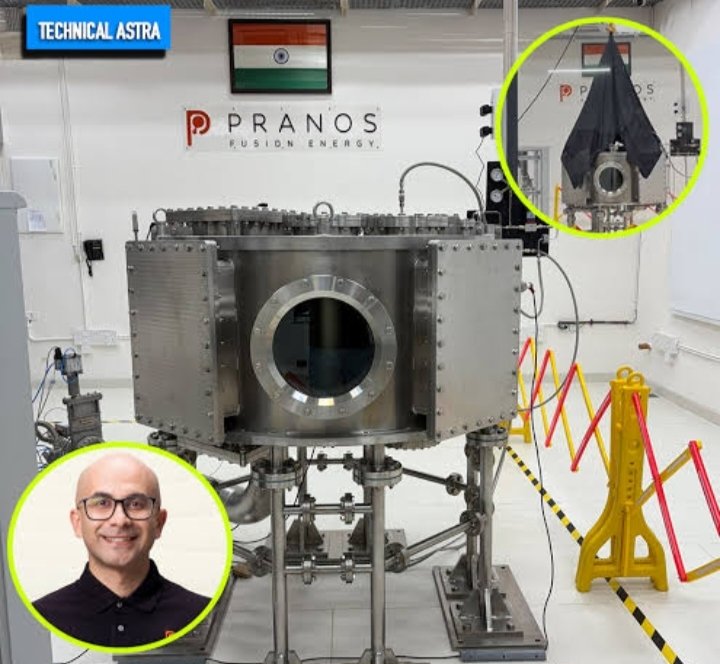
Fusion research is attracting enormous attention around the world because successful commercial fusion could potentially provide a new source of energy without the long-lived carbon emissions associated with fossil-fuel power generation.Countries and private companies are investing heavily in different fusion approaches, including tokamaks, stellarators and other experimental reactor concepts.India already has substantial experience in fusion research through its participation in international programmes and domestic facilities. The growth of private initiatives such as Pranos Fusion adds another dimension to the country’s long-term fusion strategy.The development of PRAGYA also highlights Bengaluru’s growing reputation as a hub for advanced engineering and deep-tech startups.Building a tokamak requires expertise across multiple disciplines—from mechanical and electrical engineering to materials science, superconductivity, vacuum technology, computational modelling and plasma physics.A successful private programme could therefore have significance beyond fusion itself by contributing to India’s wider advanced-technology capabilities.
The next stage of fusion development will involve improving plasma confinement and stability, developing more sophisticated control systems and demonstrating increasingly advanced fusion-relevant technologies.For PRAGYA, the significance lies in the knowledge and engineering capabilities that can be developed through experimentation. Each successful test can provide data that may help engineers design more advanced fusion systems in the future.
PRAGYA does not mean that commercial nuclear fusion has arrived in India. Instead, it represents an important step in building private Indian capability in fusion research and tokamak technology.If these efforts continue to progress, India’s private deep-tech sector could play an increasingly important role in the global search for practical fusion energy.The bigger question now is whether experimental platforms such as PRAGYA can help turn today’s plasma research into the reliable fusion power systems of tomorrow.