








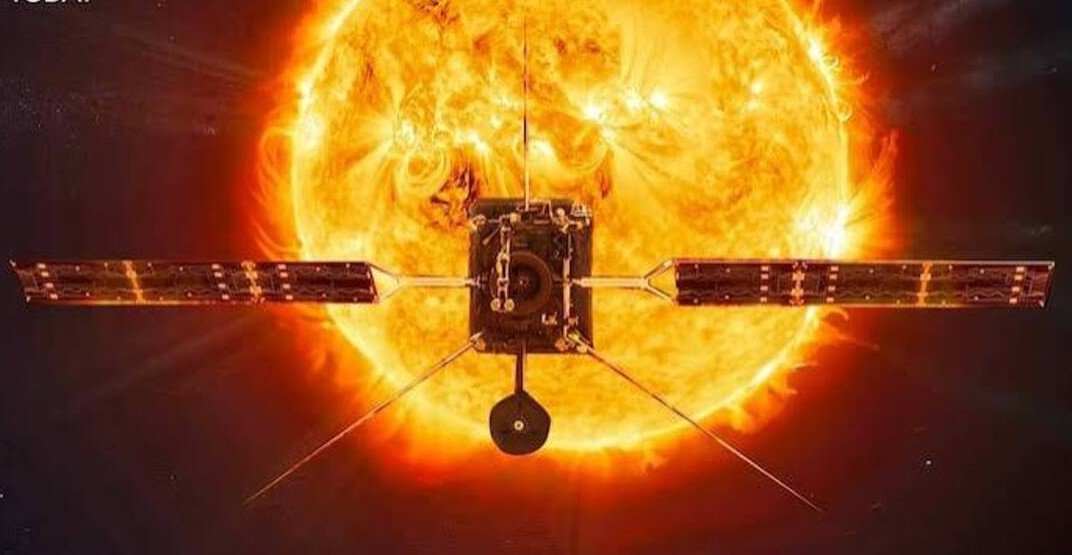
India’s first dedicated solar mission, Aditya-L1, has achieved a scientific milestone by generating Doppler velocity images of the Sun’s corona. The images, produced using the Visible Emission Line Coronagraph (VELC), offer scientists a new way to study the movement of hot plasma during solar eruptions.
The development could strengthen research into coronal mass ejections (CMEs), powerful solar events that can affect satellites, communication systems and other technologies when directed towards Earth.
How Doppler Velocity Images Work
The new images use the Doppler effect to measure the movement of solar plasma along the line of sight. Similar to how a moving vehicle’s sound changes pitch as it approaches or moves away, light can shift in wavelength depending on the motion of its source.
By analysing these shifts in light from the solar corona, scientists can identify plasma moving towards or away from the observer. This provides valuable information about the dynamics of solar eruptions.
VELC Instrument Plays a Key Role
The achievement relies on VELC, a major scientific instrument aboard Aditya-L1. Developed through collaboration between the Indian Institute of Astrophysics (IIA) and the Indian Space Research Organisation (ISRO), the instrument carries out imaging and spectroscopic observations of the solar corona.
Its ability to analyse visible-light emission lines helps researchers study the physical conditions and movement of material in the Sun’s outer atmosphere.
According to the reported findings, VELC’s unique observing capabilities from the Sun–Earth L1 region currently enable the production of these Doppler velocity images.
Why Solar Eruptions Matter to Earth
Coronal mass ejections release enormous quantities of magnetised plasma into space. When these eruptions travel towards Earth, they can disturb the planet’s magnetic environment and contribute to geomagnetic storms.
Such disturbances can affect satellite operations, radio communications, navigation systems and power infrastructure. Better observations of solar eruptions could therefore help scientists understand their evolution and improve space weather forecasting.
Supporting Future Space Weather Forecasts
Aditya-L1 operates near the Sun–Earth L1 point, approximately 1.5 million kilometres from Earth, where it can observe the Sun continuously without regular interruptions caused by Earth blocking its view.
The newly generated images add to the mission’s wider scientific capabilities. Researchers plan to make the processed images available to the scientific community alongside existing public-domain data.
The milestone highlights India’s growing contribution to solar physics and the international effort to understand solar activity. Continued observations from Aditya-L1 could provide researchers with better tools to investigate the Sun and assess the potential effects of its eruptions on Earth.