







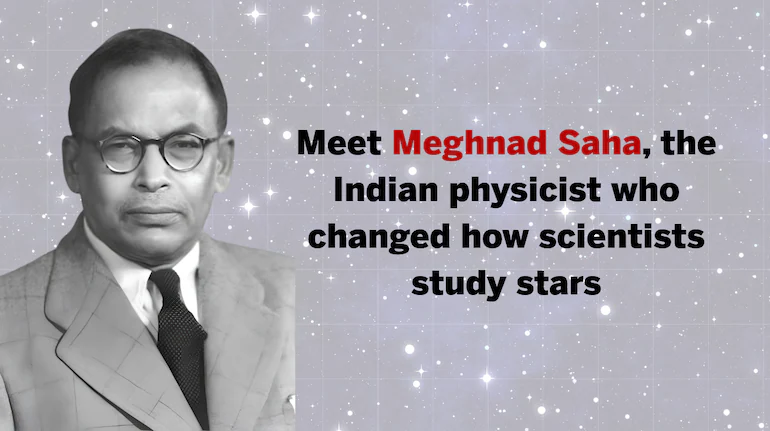
Indian physicist Meghnad Saha transformed the study of stars with a scientific equation that helped astronomers understand their temperatures and chemical properties. Despite being nominated for the Nobel Prize multiple times, he never received the award. His contribution to astrophysics, however, continues to influence scientific research decades after his death.
Born in 1893, Saha rose from a modest background to become one of India’s most influential scientists, leaving a legacy that extended beyond astronomy into education, scientific institution-building and national development.
1. From a Small Village to the World of Physics
Meghnad Saha was born on October 6, 1893, in Shaoratoli, near Dhaka, then part of the Bengal Presidency under British rule. His family had limited financial resources, and access to education was not easy.
Through academic determination and scholarships, he continued his studies and eventually attended Presidency College in Calcutta, now Kolkata. He studied alongside other leading scientific minds of his generation, including physicist Satyendra Nath Bose.
2. The Equation That Changed Astrophysics
Saha’s most influential contribution was his theory of thermal ionisation, now known through the Saha ionisation equation. The equation describes how temperature and pressure influence the ionisation of atoms in hot gases.
This was important because stars produce distinctive patterns of light known as spectra. Scientists had observed these patterns for decades, but interpreting what they revealed about stars remained a challenge.
Saha’s work helped connect these spectral patterns to the physical conditions inside stellar atmospheres, giving astronomers a more reliable way to study distant stars.
3. How Scientists Learn About Stars
A star’s light contains a spectrum with characteristic lines linked to different chemical elements. The appearance of these lines changes with temperature because atoms can lose or gain electrons under different conditions.
Saha’s equation helped explain these changes. By interpreting stellar spectra, astronomers could estimate temperatures and better understand the elements present in stars.
His research helped move astronomy beyond simply classifying stars towards explaining the physical processes behind their observed properties.
4. Seven Nobel Nominations, but No Nobel Prize
Saha was nominated for the Nobel Prize in Physics seven times, according to biographical material published by the Indian National Science Academy. Despite those nominations, he never received the award.
A Nobel nomination does not guarantee that a candidate will win, and the absence of an award does not diminish the scientific value of a discovery. The precise reasons Saha was not selected remain a matter of historical interpretation.
His equation and its continuing use in astrophysics offer a lasting measure of the importance of his work.
5. A Scientist Who Helped Build India’s Research Institutions
Saha believed scientific progress required strong institutions and wider access to education. He contributed to the development of physics research in India, helped establish scientific organisations and founded the journal Science and Culture.
He also played a role in building research capacity at Indian universities and institutions. The Saha Institute of Nuclear Physics in Kolkata was named in his honour, reflecting his lasting influence on Indian science.
6. His Contributions Extended Beyond Astronomy
Saha’s interests went beyond the study of stars. He was involved in public policy and national planning, particularly in areas related to science, education, energy and water management.
He helped shape the original plans for the Damodar Valley Project, designed to address flooding while supporting irrigation and electricity generation. He also served as a member of India’s Parliament after independence.
His career demonstrated how scientific thinking could be applied to practical challenges facing a developing nation.
7. Why Meghnad Saha’s Legacy Still Matters
Meghnad Saha died on February 16, 1956, but his contribution to astrophysics remains relevant. His work helped scientists interpret stellar spectra and understand the physical conditions of stars, forming an important part of modern astrophysical research.
His story also highlights the many ways scientific achievement can be measured. Awards bring recognition, but equations, institutions and ideas that continue to support research can leave an equally enduring mark.
Saha’s legacy is a reminder that some of the most influential scientific contributions are not always widely known outside academic circles.
