






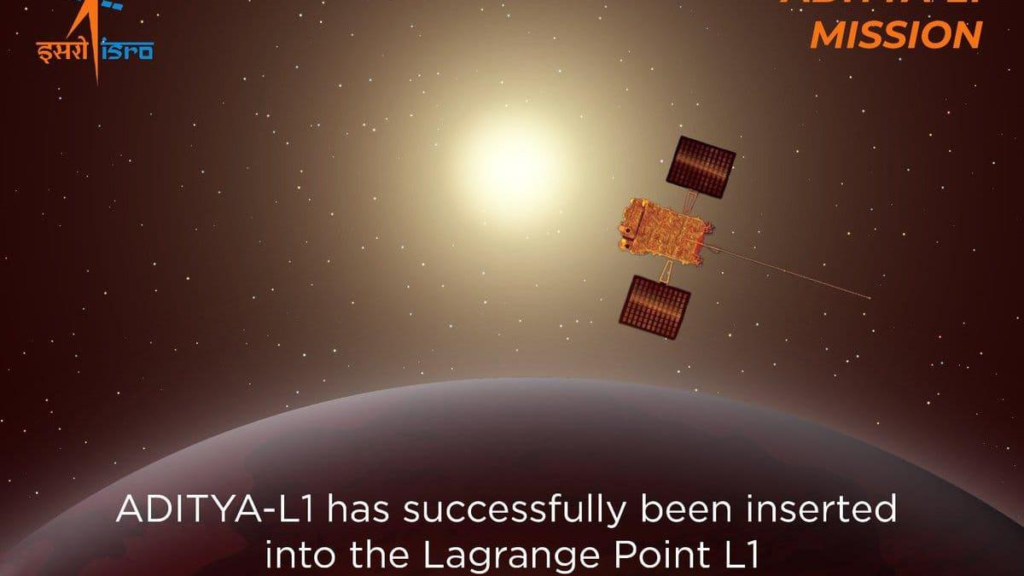
Scientists from Bengaluru have gained new insights into powerful solar eruptions by combining observations from India’s Aditya-L1 mission and Europe’s Proba-3 spacecraft. The research offers a closer look at how these eruptions develop near the Sun and distribute their energy.
Researchers at the Indian Institute of Astrophysics (IIA), Bengaluru, worked with international collaborators to analyse data from two advanced instruments aboard the missions. Their findings were published in the journal Astronomy & Astrophysics.
Two Space Missions, One Scientific Goal
The study examined coronal mass ejections (CMEs), enormous bursts of plasma and magnetic fields released by the Sun. When directed towards Earth, these eruptions can disturb the space environment and affect satellites and communication systems.
Aditya-L1’s Visible Emission Line Coronagraph (VELC) provides spectroscopic observations, while Proba-3’s ASPIICS instrument captures detailed images of the solar corona. Combining the two approaches gave scientists a more complete picture of the eruptions’ mass, density and energy.
Two Solar Eruptions Show Different Behaviour
The researchers analysed two CMEs observed simultaneously on September 14 and 16, 2025. The first travelled at approximately 645 kilometres per second, while the second moved at around 145 kilometres per second.
The study also found differences in how their energy was distributed. Thermal energy accounted for only about 1% of the total energy in the September 14 event. In the September 16 eruption, thermal energy increased until it matched the kinetic energy. The estimated magnetic energy was comparable to or greater than the kinetic energy.
Why the Findings Matter
Understanding how CMEs evolve close to the Sun can help scientists improve models of solar activity and space weather. Such research is important because intense solar disturbances can affect spacecraft, navigation systems and other technologies operating in space or on Earth.
The findings demonstrate the value of coordinated observations from multiple missions. By combining complementary instruments, scientists can investigate solar eruptions more thoroughly than by relying on a single spacecraft alone.
