





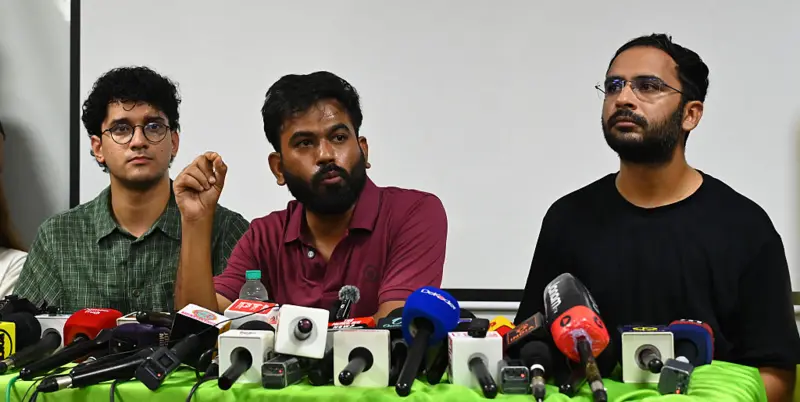
Delhi was placed under heavy security on Saturday as the Cockroach Janta Party (CJP) prepared for a major protest demanding electoral reforms and the resignation of Chief Election Commissioner Gyanesh Kumar. The group said its founder Abhijeet Dipke and co convenors Saurav Das and Ashutosh Ranka were detained after arriving in the capital. The Election Commission has denied allegations of voter-list manipulation.
1. CJP Leaders Detained Ahead of Protest
The CJP said its three prominent leaders were detained shortly after their flight from Mumbai landed in Delhi. A video shared by the group appeared to show police officers entering the aircraft. Their whereabouts remained unclear in the material available, and police had not publicly explained the reasons for their detention.
Other protesters were also reportedly detained as authorities attempted to prevent gatherings around the planned protest site at Jantar Mantar.
2. Delhi Faces Extensive Security Restrictions
Thousands of police and paramilitary personnel were deployed across the capital, with reports putting the number of additional central security personnel at around 23,000. Roads near Jantar Mantar and the Election Commission office were barricaded, while drones monitored parts of the city.
Several metro stations were closed, and train services faced disruption. Authorities also restricted gatherings in parts of Delhi. These measures drew criticism over their impact on commuters and the public, particularly after the Supreme Court urged police not to inconvenience residents by shutting down public transport.
3. What Is the CJP Movement?
The Cockroach Janta Party began as a satirical online campaign before growing into a youth-led pressure group. Dipke, a former Aam Aadmi Party associate who recently completed a master’s degree in public relations at Boston University, helped turn the idea into a wider movement.
Other prominent figures include Ashutosh Ranka, who previously worked at McKinsey & Company in London and was associated with the AAP, and Saurav Das, a former journalist known for his legal and investigative reporting.
The movement gained national attention after its earlier Delhi protest was followed by the resignation of a Union minister.
4. Why Are Protesters Demanding Electoral Reforms?
The demonstrations centre on the Election Commission’s Special Intensive Revision (SIR) of electoral rolls. The Commission says the exercise is intended to remove dead, duplicate and otherwise ineligible entries and improve voter-list accuracy.
Critics, however, fear eligible voters could be excluded. Opposition parties have also questioned whether the exercise could affect citizenship scrutiny or electoral outcomes. The government and Election Commission have rejected allegations of political manipulation.
The supplied BBC report says more than 130 million names had been left off draft voter lists across 30 states and Union territories. This figure concerns draft lists and should not automatically be interpreted as the number of eligible voters permanently removed.
5. BJP Accuses Opposition of Destabilising India
BJP president Nitin Nabin accused opposition groups of trying to destabilise India and refusing to accept the people’s electoral verdict. He alleged that associates of Congress leader Rahul Gandhi and AAP leader Arvind Kejriwal were involved in the protests.
Nabin did not name the CJP in his remarks, according to the report. The opposition has been organising demonstrations demanding Gyanesh Kumar’s resignation, while the CJP’s protest call has attracted attention beyond established political parties.
6. Dipke Says Movement Will Continue
Before his reported detention, Dipke told ANI that the prospect of arrest or legal action would not stop the movement. He said supporters would continue demanding electoral reforms and Kumar’s resignation.
Protester Sabika Muzaffar, who arrived at Jantar Mantar with her mother, said they had memorised their lawyer’s phone number because they expected to be detained. She described participating in the demonstration as a way of defending democracy.
7. Protest Puts Electoral Accountability in Focus
The latest demonstration has become part of a broader dispute over voter-list revisions, electoral transparency and the right to protest. Heavy security and travel restrictions have limited access to the planned gathering, while the reported detentions have raised questions about how authorities are managing the situation.
With important state elections approaching, the controversy is likely to remain a significant political issue. The immediate developments will depend on the authorities’ response, the status of detained protesters and any further clarification from the Election Commission.
Conclusion: The Delhi protest has brought electoral reform, voter-list accuracy and public assembly rights into sharp focus. The allegations against the Election Commission remain disputed, making transparent information and due process central to the unfolding developments.
