








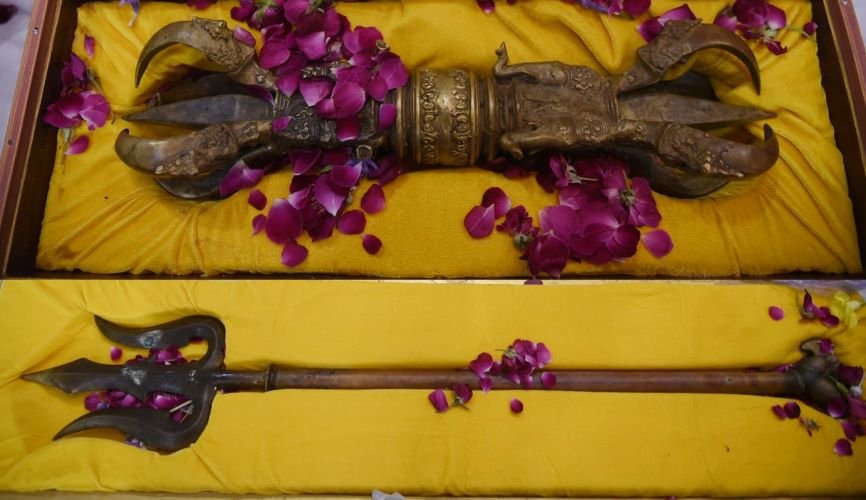
A remarkable claim about the discovery of an alleged 10,000-year-old Trishul and Vajra in the Philippines has been attracting widespread attention on social media. Images showing two large, highly detailed objects resembling traditional Hindu religious symbols are being shared with claims that they represent evidence of an ancient connection between Sanatana Dharma and the Philippines.The viral post describes the objects as extremely ancient and suggests that their discovery could challenge existing perceptions about the movement of cultures, religious symbols and traditions across Asia. The claim has generated curiosity among people interested in Hinduism, ancient civilizations, archaeology and lost history.According to the social-media post, the objects shown in the images are supposedly a Trishul and Vajra dating back around 10,000 years. The caption also mentions that the items were found in the Philippines and refers to researcher Syer Shamir Hussain, claiming that the discovery was presented with documentary evidence.The images have subsequently been reposted across social-media platforms, where users are interpreting them as possible evidence of an ancient Sanatana Dharma presence outside the Indian subcontinent.However, the viral caption itself should not be considered sufficient evidence to establish the historical age or origin of an artifact.
A date of 10,000 years would place an object in a very early period of human history. Such a claim would require particularly strong archaeological and scientific evidence.Dating an artifact involves more than examining its appearance. Experts may consider the archaeological layer in which an object was found, its surrounding materials, manufacturing technique, composition and provenance. Depending on the material and circumstances, scientific dating techniques can also be used.If an artifact were genuinely demonstrated to be 10,000 years old and conclusively identified as a Trishul or Vajra, it would raise significant historical questions about its cultural context and production.
The Trishul is one of the most recognizable symbols in Hindu religious tradition and is strongly associated with Lord Shiva. It appears in religious iconography, sculptures and temple traditions throughout the Indian cultural sphere.The Vajra is another important symbol in South Asian religious traditions. It is particularly prominent in Buddhist traditions and is also associated with Indra in Hindu mythology. The symbol is traditionally connected with concepts such as power, strength and spiritual authority.Because similar religious motifs can occur across different cultures and periods, identifying an artifact requires careful archaeological and historical analysis rather than relying only on visual resemblance.

The viral images have prompted two broad reactions online. Some users believe the objects could point toward previously unknown cultural connections between South Asia and Southeast Asia. Others have questioned the age, provenance and authenticity of the claim, noting that extraordinary historical assertions require independent verification.The discussion also highlights a broader problem with viral archaeology content. Photographs of artifacts are frequently shared without information about where they were excavated, who documented them, when they were discovered or whether specialists have examined them.Without such information, it can be difficult to distinguish a genuine archaeological discovery from an object whose history has been incorrectly described online.The photograph circulating online can demonstrate only that objects resembling a Trishul and Vajra are being displayed. It cannot, by itself, prove that they are 10,000 years old, that they originated in the Philippines, or that they provide evidence for a particular religious tradition.This distinction is important when reporting viral historical claims. A compelling photograph can generate interest, but archaeological conclusions require evidence that can be independently examined and verified.
The Philippines has a long and complex history of cultural interaction with other parts of Asia. Southeast Asia historically experienced extensive exchanges involving trade, religion, language, art and technology. This makes questions about ancient cultural connections an important area of historical research.But any specific claim linking a particular artifact to Sanatana Dharma needs to be evaluated based on the evidence associated with that artifact—not simply on its shape or the caption accompanying a viral post.The claim that 10,000-year-old Trishul and Vajra were found in the Philippines is certainly intriguing and has generated substantial discussion online. However, the available viral image and accompanying social-media caption are not enough to independently establish the objects’ age, archaeological provenance or historical significance.Until credible archaeological records, scientific dating and independent expert verification are made available, the claim is best described as an unverified viral claim. Any future documentation from recognized archaeological authorities or independent researchers could help determine whether the remarkable story has a genuine historical basis.