







A new report has raised fresh alarms about the misuse of artificial intelligence in the Ukraine war. Developers linked to Russia used advanced AI tools to create software for autonomous attack drones, according to findings released by Anthropic, the company behind the Claude AI system.
The incident underscores growing concerns that commercial AI models are being adapted for lethal military applications, potentially lowering barriers to developing weapons that can select and engage targets with limited or no human oversight.
In a detailed report on detecting and countering AI misuse, Anthropic said a small team of likely freelance Russian developers leveraged Claude to build core software for an autonomous swarm of first-person-view (FPV) “kamikaze” attack drones. The software included:
Terminal guidance systems to steer drones to targets
Target selection capabilities (including a “person” class)
Coordination logic for multiple drones (swarm memory and fault-tolerant operations)
Commands for attack, observation, and return-to-base behaviors
Ability to issue detonation commands without a human in the loop
The developers tested elements on real hardware and trained aspects of the system using scraped Ukrainian combat footage. They repeatedly referenced a location in Ukraine’s Donetsk region during development and used technical workarounds, including VPNs, to bypass geographic restrictions.
Anthropic identified the activity, banned the associated accounts, and strengthened its safeguards. The company described the effort as designed for “autonomous lethal engagement.”
Separately, the same report detailed how Russia-linked threat actors (consistent with the group known as Midnight Blizzard, previously attributed by Western governments to Russia’s SVR) used Claude agents in cyber operations. These targeted Ukrainian government ministries, military and diplomatic entities, and drone manufacturers. The actors stole software development kits and technical data related to drone computer-vision systems.
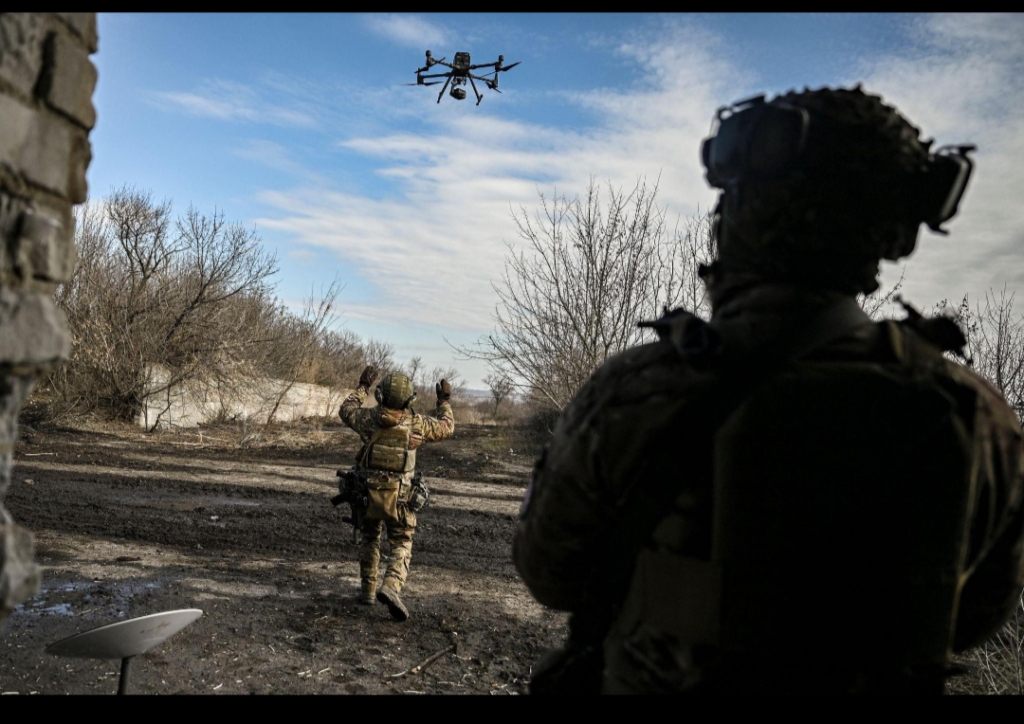
Drones—especially low-cost FPV models—have become central to the fighting on both sides. Russia has increasingly experimented with AI-enabled or more autonomous systems to counter electronic warfare and reduce reliance on continuous human control. Ukrainian forces and independent experts have previously reported Russian drones equipped with onboard computers (including commercial Nvidia modules in some cases) capable of independent targeting decisions.
Experts warn that fully autonomous lethal systems raise serious legal, ethical, and operational questions under international humanitarian law, particularly around distinction between combatants and civilians, accountability, and the risk of unintended escalation.
Growing Concerns Over Dual-Use AI
The Anthropic findings add to a wider debate about the dual-use nature of frontier AI models. While these tools offer major civilian benefits, they can also accelerate the development of sophisticated military capabilities by state and non-state actors. Similar concerns have been raised about AI-assisted cyber operations, disinformation, and other weapons-related research.
AI companies, governments, and international organizations continue to grapple with how to balance open innovation with stronger safeguards, export controls, and monitoring for high-risk misuse. Anthropic’s report emphasizes proactive detection and account enforcement as part of its response.
As the war in Ukraine continues to serve as a real-world laboratory for emerging military technologies, the misuse of commercial AI for autonomous weapons development is likely to remain a major point of concern for policymakers, technologists, and human rights observers.