







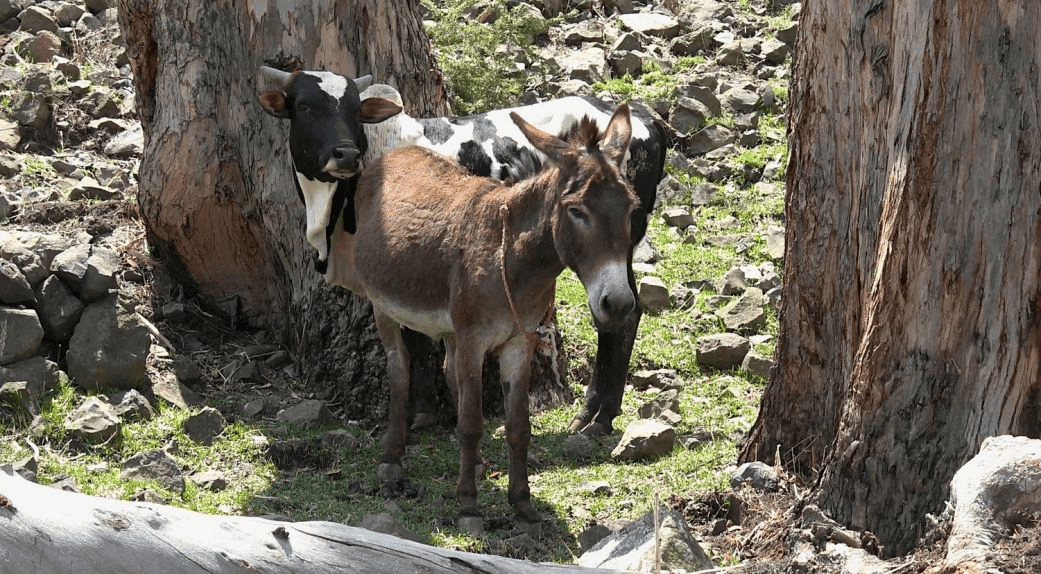
An unusual relationship between a bull and a male donkey in Ethiopia has caught the attention of scientists, offering fresh insights into animal behaviour and social bonding. Researchers have documented repeated sexual interactions and affectionate behaviour between the two animals, despite their belonging to different species.
The animals, named Achille and Patroclo, were observed by researchers from the University of Pisa in Italy. Their findings, published in the scientific journal Current Biology on November 2, 2026, describe a rare example of a sustained socio-sexual relationship between a bull and a male donkey.
How Scientists Discovered the Unusual Relationship
The researchers were initially working in the Ethiopian highlands to study gelada monkeys when they noticed something unexpected in a nearby grazing area.
They observed a bull repeatedly approaching a male donkey and attempting to mount him. What made the encounter particularly interesting was that the donkey did not show the avoidance or defensive behaviour commonly seen when other male donkeys were approached.
The scientists subsequently began observing the pair more systematically to understand the nature of their interactions.
Achille and Patroclo: The Unusual Animal Pair
The researchers named the bull Achille and the donkey Patroclo, inspired by the ancient Greek figures Achilles and Patroclus from Homer’s Iliad.
The two animals belonged to different owners and encountered each other when their herds shared grazing land. Despite having access to other animals of their own species, they repeatedly sought each other’s company.
Their interactions included licking, rubbing, nuzzling and other friendly physical contact, alongside repeated mounting behaviour.
Researchers Record 51 Mounting Incidents
During observations conducted between March 6 and March 19, 2026, researchers recorded 51 mounting incidents involving Achille and Patroclo. According to the published study, 34 of these incidents involved penetration.
The researchers also noticed that the donkey frequently appeared to participate willingly. He sometimes presented his hindquarters to the bull and initiated friendly contact.
The pair often remained close after the sexual interactions, continuing to lick and rub against each other. This repeated behaviour suggested that their association involved more than isolated mating attempts.
Why the Behaviour Surprised Scientists
Same-sex sexual behaviour has been documented across numerous animal species. However, sustained socio-sexual interactions between animals belonging to different taxonomic families are considerably less commonly reported.
The researchers were particularly interested because neither animal appeared to lack alternative partners. Both had opportunities to interact with males and females of their own species.
The consistency of their preference for each other therefore raised questions about the relationship’s social significance.
Could Sexual Behaviour Strengthen Social Bonds?
The researchers suggest that sexual interactions may sometimes contribute to social relationships beyond reproduction. In the case of Achille and Patroclo, repeated friendly contact before and after mounting could indicate a strong social association.
However, scientists have cautioned against drawing definite conclusions about the animals’ emotions or motivations. The study documents observable behaviour but cannot establish exactly what the animals experienced.
The researchers believe further investigations could help explain whether such interactions contribute to companionship, social bonding or other behavioural functions.
What the Discovery Reveals About Animal Behaviour
The study adds to scientific understanding of the diversity of sexual and social behaviour in the animal kingdom. It also challenges the assumption that every sexual interaction between animals must have a reproductive purpose.
The researchers describe the observation as an important starting point for further work on relationships between different species.
However, this single case cannot establish how common such relationships are or explain their evolutionary significance. More observations involving different animal populations will be necessary.
Scientists Hope to Observe the Pair Again
After the observation period, the two animals were moved to different grazing locations as the local dry season affected pasture availability.
Researchers hope that Achille and Patroclo may meet again when their herds return to shared grazing areas. Further observations could help determine whether their unusual association continues.
For scientists, the story is a reminder that animal behaviour can be more complex and varied than previously understood. What began as an unexpected observation during fieldwork has become an interesting research subject in the study of animal social relationships.