



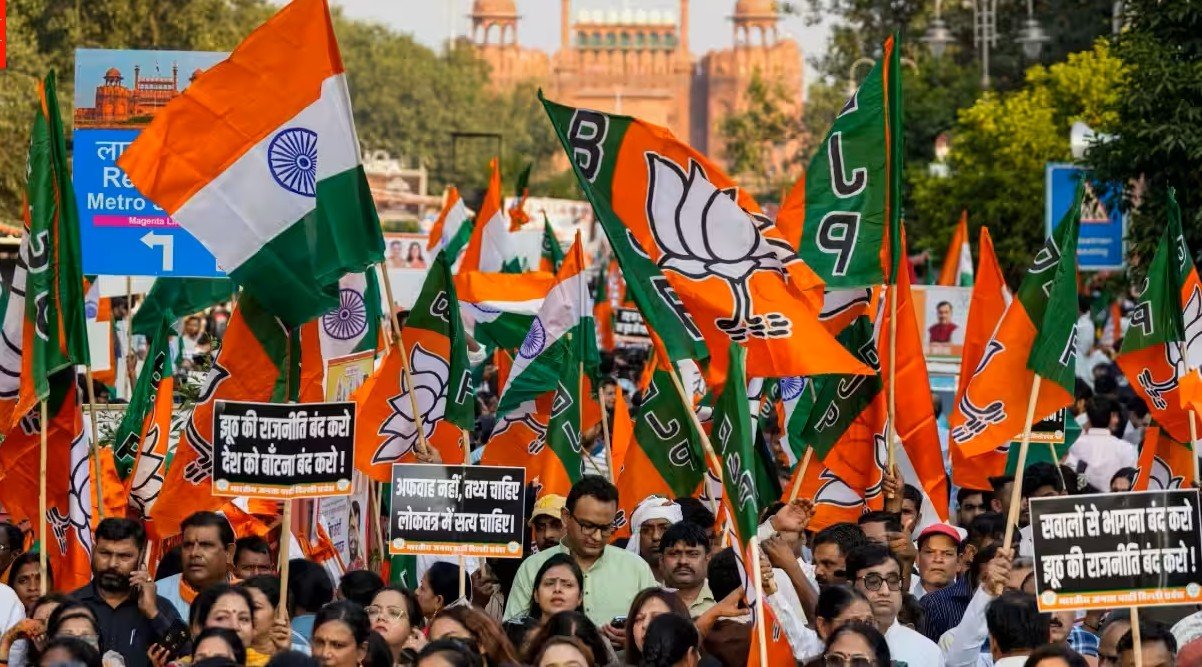
The Bharatiya Janata Party (BJP) organised a protest march in West Delhi on November 1, calling on the Congress to apologise for the 1984 anti-Sikh violence. The demonstration took place on the same day as the INDIA bloc’s rally at Ramlila Maidan, where opposition leaders protested against alleged irregularities in electoral rolls and demanded the resignation of Chief Election Commissioner Gyanesh Kumar.
The BJP march began at Hari Nagar bus depot and continued towards Tilak Nagar Metro Station, passing through areas with a significant Sikh population. Party leaders and members of the Sikh community participated, carrying flags and placards and raising slogans against the Congress.
Hardeep Singh Puri Leads the Protest
Union Minister Hardeep Singh Puri led the march alongside Delhi Chief Minister Rekha Gupta, Delhi minister Manjinder Singh Sirsa, BJP state president Harsh Malhotra and other party leaders. Senior advocate H.S. Phoolka and several Sikh community representatives also took part.
Puri described the 1984 violence as a planned massacre rather than spontaneous public unrest. Referring to official figures, he said 2,733 people were killed in Delhi during the violence and argued that the victims and their families deserved continued recognition and justice.
BJP Calls for an Apology from Congress
A central demand of the demonstration was an apology from the Congress leadership for the killings of Sikhs in 1984. BJP representatives argued that holding a major political rally on November 1 was insensitive because the date marks the beginning of widespread violence against the Sikh community following the assassination of then Prime Minister Indira Gandhi.
The BJP also questioned the Congress’s decision to organise its political event on a day associated with painful memories for survivors and their families.
Rekha Gupta Recalls the Experiences of Sikh Families
Delhi Chief Minister Rekha Gupta spoke about the impact of the violence on Sikh families. She recalled that a Sikh neighbour had taken shelter at her parents’ home during that period.
Gupta also referred to the fear experienced by members of the community, including people who reportedly changed their appearance to protect their identities. Her remarks formed part of the BJP’s wider criticism of the Congress over the timing of the INDIA bloc rally.
A Separate Political Demonstration in Delhi
The BJP’s march took place as opposition parties gathered at Ramlila Maidan for their ‘Vote Bachao, Desh Bachao’ campaign. The INDIA bloc’s demonstration focused on alleged voter-list irregularities and the Special Intensive Revision (SIR) exercise.
The two events highlighted the competing political narratives surrounding the same date. While opposition leaders used their rally to question the Election Commission’s handling of electoral rolls, the BJP focused on the legacy of the 1984 violence and its criticism of the Congress.
Congress Response Awaited
The BJP’s march added another dimension to the political confrontation in the national capital. The party reiterated its demand for an apology, while its leaders used the demonstration to highlight the experiences of Sikh families affected by the 1984 violence.
A response from the Congress to the specific allegations raised during the march was awaited at the time of publication. The competing demonstrations underscored how historical memory and current political disputes became intertwined in Delhi’s public debate.