




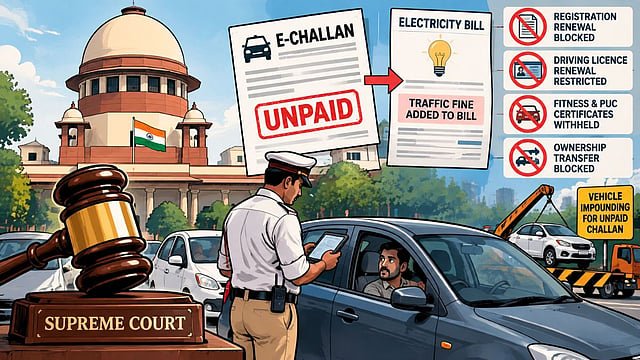
The Supreme Court has suggested a possible new approach to recover unpaid traffic challans by linking outstanding fines with electricity bills. The suggestion was made during a hearing concerning the recovery of unpaid e-challan amounts and enforcement of traffic violations.
A Bench comprising Justices JB Pardiwala and KV Viswanathan discussed the need for authorities to focus not only on issuing e-challans but also on recovering the fines from violators. Reports said the Court was informed about a large amount of pending e-challan dues across states and Union Territories.
During the hearing, the Court suggested exploring whether unpaid traffic fines could be added to electricity dues. The idea was discussed as one possible mechanism to encourage people to clear their pending challans.However, this was a suggestion made during the hearing and not an order directing immediate implementation.
The Court also discussed other possible recovery measures, including restricting vehicle registration renewals, ownership transfers, fitness certificates and driving licence renewals when traffic challans remain unpaid. Authorities could also consider flagging vehicles with pending challans on the Parivahan portal and carrying out random checks.
The discussion highlights the larger challenge of recovering traffic penalties after e-challans are issued. The Supreme Court indicated that enforcement mechanisms need to address the actual collection of fines rather than stopping at the issuance of challans.
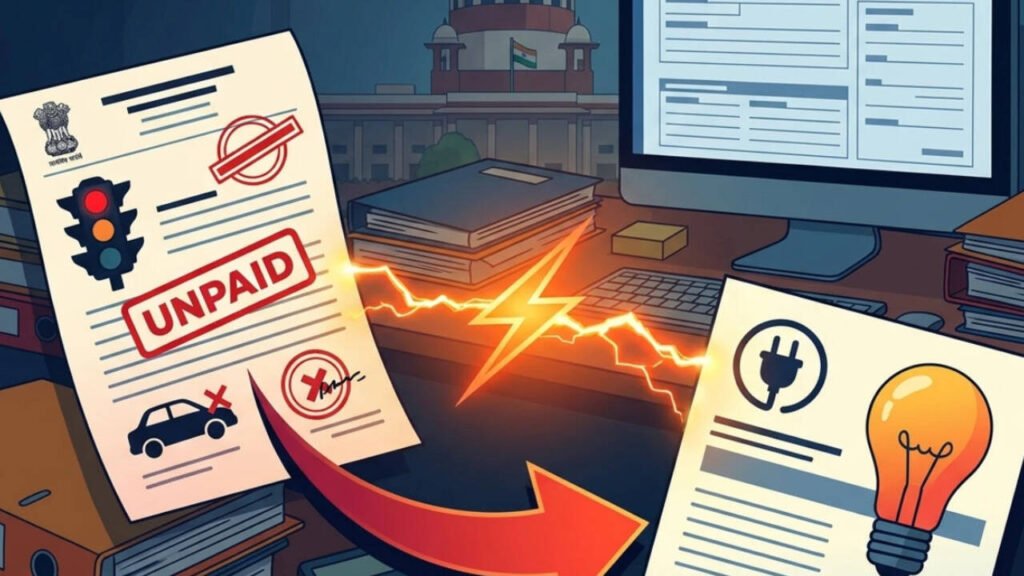
The broader issue is the growing number of unpaid e-challans. Traffic authorities increasingly use digital systems to detect violations such as speeding, jumping red lights and other road-rule violations. While e-challans make it easier to issue penalties, ensuring that the fines are eventually paid remains a challenge.
If such recovery mechanisms are introduced, motorists with pending challans could face additional restrictions when accessing certain vehicle or government services. The objective would be to create a stronger connection between traffic-rule violations and timely payment of penalties.
For vehicle owners, the discussion is also a reminder to regularly check their e-challan status and clear legitimate pending fines through official government channels. At present, motorists should not assume that an unpaid challan will automatically appear on their electricity bill.
The Supreme Court’s discussion has therefore attracted attention because it explores a different approach to traffic-fine recovery. Whether electricity bills will eventually be used for this purpose will depend on further proceedings and decisions by the relevant authorities.