








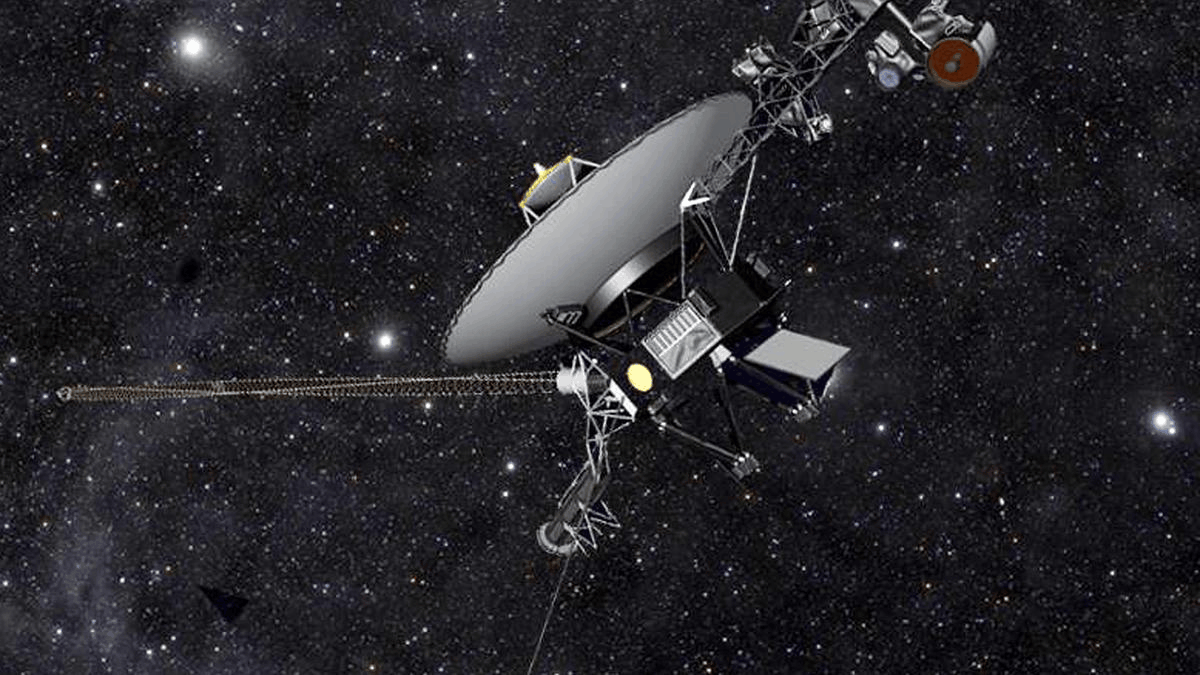
NASA’s Voyager 1 spacecraft is set to achieve an extraordinary milestone on November 18, 2026, becoming the first human-made object to travel one light-day away from Earth. Launched in 1977, the spacecraft has spent nearly five decades travelling through deep space and continues to send scientific information back to Earth.
The achievement highlights the remarkable endurance of one of humanity’s most ambitious space exploration missions. At this distance, even a radio signal travelling at the speed of light takes approximately 24 hours to reach the spacecraft.
What Does One Light-Day Mean?
A light-day is the distance light travels in 24 hours. It is approximately 16.09 billion miles or 25.9 billion kilometres.
Light moves at nearly 300,000 kilometres per second, making it the fastest known form of communication across space. Voyager 1 reaching this distance demonstrates just how far the spacecraft has travelled from its home planet.
To understand the scale, sunlight takes around eight minutes and 20 seconds to reach Earth, while light takes approximately four hours to travel from Earth to Neptune.
Launched in 1977, Voyager 1 Continues Its Journey
NASA launched Voyager 1 on September 5, 1977, to explore the outer planets. It flew past Jupiter and Saturn, capturing valuable scientific observations and images before continuing towards interstellar space.
In August 2012, it crossed the heliopause, the boundary marking the end of the Sun’s protective bubble of particles and magnetic fields. This made it the first spacecraft to enter interstellar space.
Communication With Earth Takes Longer Than Ever
Voyager 1’s enormous distance creates a major challenge for NASA engineers. A radio command sent from Earth takes approximately 24 hours to reach the spacecraft, while its response takes another 24 hours to return.
This means a complete communication exchange can take around two days. Engineers cannot operate the spacecraft in real time and must carefully plan commands before waiting for confirmation.
Despite the delay, Voyager 1 continues to transmit valuable information about the environment beyond the heliosphere.
Voyager 1 Still Sends Scientific Data
Although several of its instruments have been switched off over the years to conserve power, Voyager 1 remains operational.
According to NASA’s mission status information, its magnetometer and plasma wave subsystem are still functioning. These instruments help scientists study magnetic fields and plasma conditions in interstellar space.
The spacecraft’s continued operation is particularly remarkable because it was designed using technology from the 1970s.
Voyager 2 Is Expected to Reach the Milestone in 2035
Voyager 1’s twin spacecraft, Voyager 2, was launched on August 20, 1977. It followed a different route, visiting Jupiter, Saturn, Uranus and Neptune before entering interstellar space in 2018.
NASA estimates that Voyager 2 will reach the one-light-day distance from Earth in November 2035.
Both spacecraft have made important contributions to our understanding of the outer planets and the space beyond our solar system.
Voyager 1 Is Heading Towards Another Star
Voyager 1 is travelling in the direction of a star known as Gliese 445, also identified as AC +79 3888, located more than 17 light-years from Earth.
NASA estimates that the spacecraft could pass within approximately 1.7 light-years of this star in around 40,000 years.
Although it will not reach the star anytime soon, its journey represents an extraordinary human achievement and a lasting symbol of scientific exploration.
A Remarkable Achievement in Space Exploration
Voyager 1’s one-light-day milestone is more than a distance record. It demonstrates how far human technology can travel and how scientific missions can continue delivering discoveries decades after launch.
Carrying the famous Golden Record, which contains sounds and images representing life on Earth, Voyager 1 continues its journey through interstellar space as humanity’s most distant messenger